
Got Milk? Too Much, Apparently.

The first two days of this week have been relatively quiet compared to previous weeks, with only 330mt of cheese and no trades on butter and powders the week still needs to find its second gear. We expected a bit of a slowdown, with most partners in Cologne searching for new connections, business, and answers. We spoke with several contacts about the overall sentiment — but to be honest, no one seems to have learned anything new.
The EU dairy market still feels weak — how weak depends on who you ask. One partner summed it up quite nicely:
- The optimists believe all the bearish news is already priced in and that the market will turn as soon as some positive data shows up.
- The pessimists think we’re only at the beginning and that EU prices could drop another 25% once the seasonal milk flush starts.
- And the realists? They just take it week by week, trading the opportunities in front of them.
For those realists, we stand ready to help identify, quantify, and execute those opportunities.
Got Milk? Plenty.
The optimists might have to hold their breath a bit longer for bullish data. So far this week, the numbers have been overwhelmingly bearish. Poland and Ireland both report strong milk intakes. Ireland collected 6.8% more milk in August (7.3% more on milk solids), producing 8.4% more butter than last year. In Poland, August milk production was up 4.9%.
Germany’s latest weekly figures tell the same story — week 39 saw 4.2% more milk, resulting in 27% more butter, 45% more SMP, and 7% more cheese production. Partners close to the farmgate tell us that Belgium and France are seeing similar trends.
All that extra milk is pushing raw milk prices down, though Italy still seems to pay relatively well for the coming weeks. Spot milk, however, is under heavy pressure — trading well below 30 cents, with some claiming to have bought even cheaper loads. Cream prices are holding up better. This week’s levels opened slightly lower, around €6,050–€6,150, just under last week’s €6,150–€6,300 highs.
GDT Looking Down
There wasn’t much bullish news from yesterday’s GDT either. Only AMF and Cheddar managed small increases; the rest of the tender came in weak. The overall result of -1.6% was pretty much in line with our expectation of a ~2% drop.
Butter fell 3%, with Solarec prices averaging around €5,450 for November through January — roughly matching EEX futures and sitting just above recent NL/DE/BE trade levels. Fresh Solarec butter usually carries a small premium, of course. New Zealand butter also slipped, but still trades about €300 above EU levels. That’s close enough to make EU butter almost competitive in Southeast Asia. Meanwhile, some African buyers are switching to US butter, offered just above $5,250 — and in times of high inflation, not everyone can afford the “usual brand” when there’s a $1,500 discount on the table.
WMP took a heavy hit with a 2.3% drop, which weighed heavily on the overall tender. The added volumes were already pointing to a bearish outcome. SMP stayed mostly flat, down just 0.5% — EU powders continue to trade steadily between €2,100 and €2,150.
The biggest surprise (though maybe not really a surprise anymore) came from mozzarella. We’ve been trading cheese lower for weeks now, and the tender confirmed it with a minus of 12% — prices settled just above and below €2,900. Afterwards, we managed to broker a Q1 EU mozzarella deal at €2,980.
From a European perspective, the GDT confirms what we’ve been seeing: cheese remains weak, and butter and powders are holding ground — but just barely. And before you ask: no, we don’t have buyers lined up for €5,450 butter in Nov/Dec/Jan. Apart from a few premium buyers for Solarec, there’s little interest at those levels.
Export Levels Within Reach
So far, it’s been bearish data all around — bearish GDT, bearish Anuga sentiment, bearish milk, bearish production. But let’s give the bulls something to hold on to: the lower we go, the closer we get to export-competitive prices.
The EU badly needs cheese exports. With Gouda near €3,000 and mozzarella below that, the export window might finally reopen. We’re hearing the first deals being concluded, even if volumes are still small and follow-up bids come in lower. Still, markets like Korea, Japan, and Taiwan are back at the table — at least open for discussion again.
Butter exports are also picking up a bit, though mostly in small, targeted volumes. Some partners say they’re in tight competition with US butter. From a European price base, EU butter would need to sell at around $6,700 to make a profit, while US butter is available between $4,900 and $5,200 — a tempting $1,500 difference for budget-conscious buyers.
On the powder side, the gap is much smaller. EU exporters are within a few dollars per ton of being competitive. A $100 drop might be enough to trigger some meaningful export business, which could help set a market floor. The main issue, however, is timing — many export orders are for next year, while the cheap product needs to move now. That stock pressure might nudge EU prices a bit lower this year, but Q1 levels around €2,100 look well supported. And with the fx rate improving (at the moment of writing at 1.165), exports for powders can become active again quickly.
Butter: Stable with Stock Pressure
Calling the butter market weak would be unfair — we see plenty of buyers for Q2 and beyond. Calling it firm would be overstating it, as there are virtually no buyers for the next three months. The fairest word is probably stable, but it sure doesn’t feel that way.
Give us 1,000 mt of butter to sell for Q4, even at €5,100, and we honestly wouldn’t know where to place it. That tells you everything about the fundamentals. Yet, give us a €5,500 bid for Q2, same volume, and we doubt we could fill more than 25% before higher offers start popping up — that tells you a lot about sentiment.
And even if you’d hand us the bid and the offer at the same time, for the same product, we doubt we’d find a single trader willing to execute both sides. That says plenty about the current appetite for financing, stocking, and carrying product forward.
Risk Appetite Has Shifted
We already hinted at this in our previous article — risk mitigation for next year matters far more to buyers (who often have fixed retail contracts to hedge) than to sellers. Most natural sellers are co-ops, and they only know their true Q2 cost price once their milk price is set or in range. Since milk prices follow the market, they’ll obviously try to maximise what they can pay their farmers, but they won't speculate on their behalf.
But unlike end users, who are buying against fixed downstream deals, co-ops risk selling too low if the market moves up. That’s where traders are supposed to step in — taking on that forward risk. The problem is that traders’ risk appetite seems maxed out. Most are now waiting for producers to come back to the market. But that could take a while.
Meanwhile, end users and traders appear extremely well covered for 2025, while producers remain eager to sell. The €400 gap between Q4 and Q2 isn’t enough to trigger cash-and-carry trades. That means either end users will have to pay up, or producers will have to adjust prices further down.
The answer to where the market goes next depends on who moves first. And with time working in favor of the buyers, we expect producers will have to lower their Q4 prices to attract partners for cash-and-carry business — likely pushing EU butter prices for Q4 below €5,000.
We start with the following market
- October/November Candia offer at € 5350 FCA NL and a € 5000 bid
- Q4 Irish butter offer at € 5300 FCA NL/IE with a bid at € 5000
- Q4 NL/DE/BE offer at € 5400 and a bid at € 5200
- Q1 NL/DE/BE offer at € 5450 and a bid at € 5300
- Q2 NL/DE/BE offer at € 5650 and a bid at € 5450
- H1 Polish Sweet cream offer at € 5500 and a bid at € 5350
- H1 HL/DE/BE offer at € 5550 and at bid at € 5400
We have 2 swap proposals
- 4 trucks frozen Dutch butter v.s. 4 trucks Arla DK butter at a € 100,- discount for October
- 9 trucks of Irish butter FCA NL v.s. 9 trucks of Candia butter FCA NL at a € 100,- discount for November/December/January
Cheese: Pressure Push
Traders often like to talk about butter’s volatility, but over the past three months, cheese has arguably been far more brutal. After peaking around €4,400 in June, we traded the first Q1 volumes below €3,000 just yesterday. With Gouda at €2,990 and Mozzarella at €2,980, cheese has officially dipped under the psychological €3,000 mark.
Honestly, we would’ve bet that butter would fall below €5,000 before cheese dropped under €3,000 — but we were wrong. As mentioned before, the fundamentals in cheese show up faster. It’s not a product that stores well or gains value with age — quite the opposite.
Structural Pressure Building
Cheese is facing a perfect storm. Production capacity has ramped up rapidly, milk volumes are higher than forecast for this time of year, and export volumes are unlikely to improve before Q1. Meanwhile, EU demand is softening. The real issue is that cheese doesn’t have a natural safety net. Butter and powder can be stored when the carry between nearby and forward months grows — cheese can’t. With limited storage life, oversupply hits harder and faster. Three months of overproduction could easily push prices down another 20–30 cents per kilo in a short window easily we think.
We expect to have the following market for cheese
- November/December Gouda offer at € 3075
- Q1 NL/DE Gouda 48% offer at € 3025 and bid at € 2925
- Q1 NL/DE/BE/DK Mozzarella offer at € 3025 and bid at € 2875
- Q2 NL/DE/BE/DK Mozzrella offer at € 3150 and bid at € 3050
- Q2/3 bid NL/BE/DE/DK Mozzrella bid at € 3200
Powders: Bottom Buyers and Stock Sellers
The powder market hasn’t been easy to spark into life. Buyers only engage when prices look truly attractive, and the bottom-feeders of the market are doing exactly that — picking up only what looks like a bargain. With sheds still full and end users sitting on comfortable stocks, there’s little activity among our usual go-to players, the traders.
Looking at recent GDT price action, it mirrors exactly what we’ve seen these past days. Buyers prefer fresh Solarec material at €2,110 over older stock at €2,100. Sellers, meanwhile, aren’t eager to part with product unless they can replace it with forward purchases around the same level.
That tells us most of our partners don’t want to increase their short exposure but are also sitting on enough inventory to avoid buying. Still, with global SMP sentiment stabilising and the FX rate supporting exports, don’t be surprised if buyers start stepping in soon — catching a few “just-above-the-bottom bites.”
We have the following indicative bids to share:
- 300mt Q1 BB Kosher & Halal SMP, EU26, €2100 fca nl/be/de
- 200mt any exportable SMP wpni max 3.5%, €2050 ex plant, Q4
- 200mt codex MH, BB or small bags, Oct/Nov €2030 dap NL
- 200mt High Protein SMP, min. 36% as is or higher, BB or 25kgs €2125 dap NL
- 150mt BMP Esm/Lactalis/Friesland/F&S/Muller/Rucker, fresh, Oct/Nov shipment, $2600-2620 CIF Manila
- 100mt Uelzena SMP MH, fresh, Oct, CIF Surabaya $2500
- 44mt Arla UK SMP, 25kgs, Dec collection, €2100 ex
- 44mt Yew Tree Low Heat, 25kgs, October collection, €2150 fca NL
- 44mt Arla WMP, 25kgs, Dec/Jan collection, €3600 ex plant
- 25mt Frischli/Arla UK SMP MH, 25kgs, Oct/Nov collection, €2050 fca NL
Final Note
So yes, sentiment remains heavy, volumes modest, and confidence somewhere between “waiting” and “wandering.” But as we all know, dairy has a way of turning just when most people stop watching. For now, we keep trading what’s in front of us, listening carefully to what the market isn’t saying — and that often tells us more than the data ever could.
After all, we’re in the dairy trade: not for the faint-hearted, not for the overconfident — but definitely for those who can take a punch, smile, and still ask, “Got milk?”
More from the desk
Our Long View Before Our Long Break 
Our Long View Before Our Long Break
Last week the market found a bit of stability. After lower trades on cheese, the cheese market traded slowly up, although a real rally remains absent. Butter prices did dip a bit further, although at the start of this week we see some strength on the back end of the curve. And on powder, our bullish feeling just doesn't go away — and now we can find some confirmation in the market as well.
Dairy Carry Has a Shelf Life 
Dairy Carry Has a Shelf Life
Last week was bearish across the board — every product we broker leaned the wrong way. Powders lost more momentum, cheese slipped well below €3,000 for some products, and butter continues to impress with just how much keeps showing up. Supply, supply, supply.
Summer Shopping or Summer Sale? 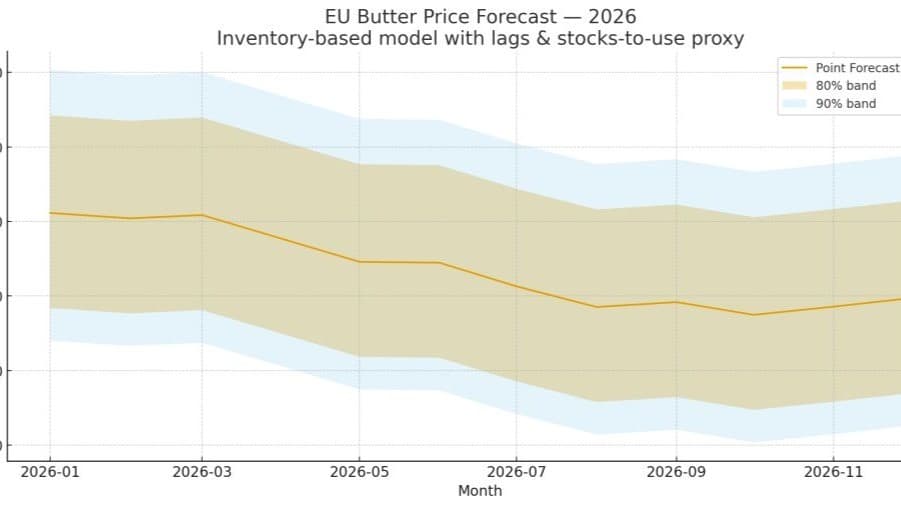
Summer Shopping or Summer Sale?
Last week was again a bit of a bearish week for the entire dairy industry. With cream prices under pressure and milk intake still strong, we keep seeing a market that has more supply than demand. Butter prices took another step lower, cheese prices cracked, and the powder market gave back a bit of its gains again.
The weekly report
Get it before it is anywhere else
Every market report, straight to your inbox the moment it is written. Butter, cheese, powder, liquids — pick what you actually trade.
Roughly weekly · Free · Unsubscribe any time