Down After Easter?

Last week the market didn't show an awful lot of price movement on cheese and butter, it was only the market for powders that significantly traded lower. For butter and cheese, we see that a lot of partners expect the prices to trade lower. "After easter the price will have to drop!" is a much heard sentence. "It always does" and "In the milkpeak producers have to sell" are the most heard sentences after that. But do prices have to drop? Do they always drop after easter, and does the milkpeak bring the pressure to take down market prices?
Repeated exposure to such claims can lead one to accept them as truths, but a closer examination reveals a different reality. Contrary to popular belief, historical data suggests that prices tend to rise after Easter.
Increased Milk Supply and Demand Dynamics
The assumption that prices should decrease after Easter is not unfounded. Traditionally, Easter marks the beginning of the milk season, accompanied by rising temperatures, cows grazing outdoors, and consequently, higher milk production. Basic economic principles dictate that when supply rises, prices fall. However, this surge in supply coincides with a spike in demand as well. The post-Easter period sees a rise in the consumption of fresh produce and dairy products like cream and ice cream, offsetting some of the pressure created by increased milk production.
Mass Anticipation of Discounts
The anticipation of post-Easter discounts often leads buyers to postpone purchases until prices drop. This behavior is reminiscent of the pattern observed around Christmas, where buyers hold off for Christmas cream and Christmas milk. Conversations with end-users reflect a similar desire for lower prices this year after easter, particularly in the cheese and butter market segments.
However, the situation differs for Skimmed Milk Powder (SMP), where current market levels offer little incentive for buyers to hold off on purchases. With prices hovering near yearly lows, the market appears saturated, awaiting a resurgence in demand to drive prices upward.
History Shows, Q2 up, Q2 down
Looking at the butter quotations for the last 5 years we see that only a clear drop can be seen in 2020 in the recent year. But with COVID hitting the market for the first time, and the market going into full lockdown, we know of few commodities that traded firm in that quarter For other years we mainly see prices in Q2 (mainly April and May) trading steady v.s. Q1 or even a bit higher. It does seem that the third quarter of most years is a bit weaker compared to the second quarter. This might have to do with more buyers leaving on holiday and less trading activity. For cheese, we see a similar picture. In the last 5 years, Q2 prices have traded steady or above Q1 prices. Only in Q2 2020 (COVID), prices traded down. SMP shows a bit different pattern. In the last years, prices in Q2 have moved up just as often as they moved down or stayed stable.
Check out the date yourself via the CLAL butter or via CLAL cheese
So do we go up?
Contrary to expectations, our analysis does not necessarily suggest an imminent upward trend in prices post-Easter. Instead, we caution against the assumption that prices will inevitably drop during this period. Factors such as delayed purchasing decisions by buyers and a lack of selling pressure on producers challenge this notion. While butter production lags behind last year's levels and cheese is still very young when leaving the factory, the pressure on producers appears confined to the powder market segment. Our outlook remains bullish on butter, stable to slightly bullish on cheese, and bearish on powders.
More from the desk
Our Long View Before Our Long Break 
Our Long View Before Our Long Break
Last week the market found a bit of stability. After lower trades on cheese, the cheese market traded slowly up, although a real rally remains absent. Butter prices did dip a bit further, although at the start of this week we see some strength on the back end of the curve. And on powder, our bullish feeling just doesn't go away — and now we can find some confirmation in the market as well.
Dairy Carry Has a Shelf Life 
Dairy Carry Has a Shelf Life
Last week was bearish across the board — every product we broker leaned the wrong way. Powders lost more momentum, cheese slipped well below €3,000 for some products, and butter continues to impress with just how much keeps showing up. Supply, supply, supply.
Summer Shopping or Summer Sale? 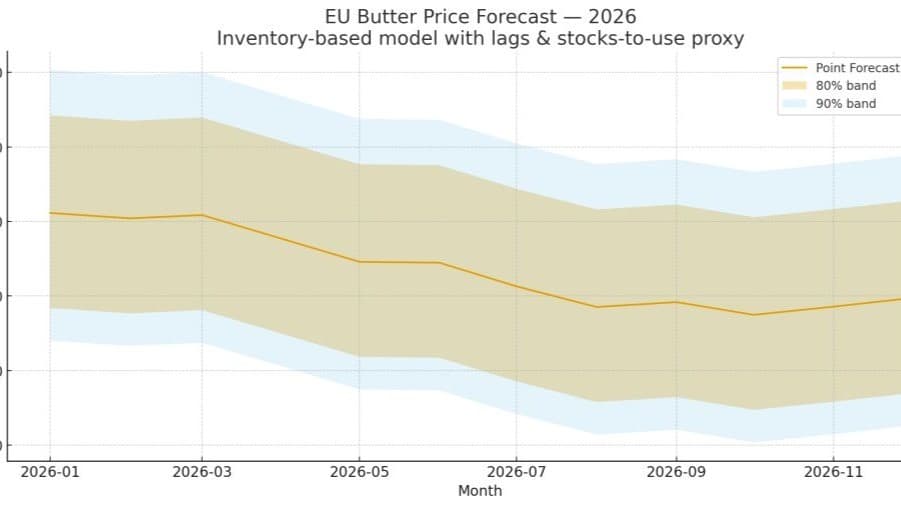
Summer Shopping or Summer Sale?
Last week was again a bit of a bearish week for the entire dairy industry. With cream prices under pressure and milk intake still strong, we keep seeing a market that has more supply than demand. Butter prices took another step lower, cheese prices cracked, and the powder market gave back a bit of its gains again.
The weekly report
Get it before it is anywhere else
Every market report, straight to your inbox the moment it is written. Butter, cheese, powder, liquids — pick what you actually trade.
Roughly weekly · Free · Unsubscribe any time