Sideways with a Searchlight

What to write about a market that refuses to give us a headline? And what to report when trades are fewer, liquidity is thinner, and market makers are less outspoken than they were a few weeks ago? Is this market really trading sideways? On butter, it depends very much on who you ask and what your reference points are. On SMP, some will tell you a bearish story given a few cheaper spot offers in the market, while others report increased forward sales opportunities. And on cheese, a few weeks of "sideways" trading have lifted prices by roughly €200… that's not really sideways trading, we would say. But to call the cheese market bullish, or in a rally? Are we seeing a lot of buyers?
And then back to our own market view. We are not known for our nuance, nor for our prudent market predictions. We like to be bold, outspoken, and with a steady route to destination. But even our own market compass is turning around, looking for direction. And it's not as if the market doesn't show us clear data. It does! Milk intake is strong worldwide. The increases YoY start to fade, but we are also beginning to overlap the strong milk intake of last year. Stock data, full warehouses on butter, and anecdotal stories about covered demand are clear. But even our inner butter bear seems to be silent, looking for some rest.
Let's face it. This market has taken more sudden twists and turns without notice or logic, that to expect a logical move over the next month is, in itself, illogical… Is this becoming too philosophical? Let us just present the information as we see it per category and let the market take its course from here.
Butter: Tired Bears and Absent Bulls
The butter market is our most active market, and the one we have been most outspoken about. Our first bearish reports came early 2025, and while our timing was a bit early, we think we have witnessed a move that was both logical and predictable. Our own data now suggests that the way up from here makes little sense, but the way down carries little reward either. Not for end users speculating on buying a few cents lower, not for traders shorting this and expecting cheap opportunities, and not for producers — who carry little risk in selling this market even lower than they can today. The downside is €400–€600 max. The upside is over €4,000. That's a tenfold asymmetry, and not in favour of the bears.
The bears that frontran this market to absorb the rewards have become tired. Some will still have short positions to fill, and most will do so in the final move down. But increasing a short this close to the bottom would be viewed by most stakeholders as a casino move, not a wise trade.
Are we now calling the bottom? Not really. We still expect downside on butter. Stocks are a real issue. Warehouses are full, traders are looking for unusual storage capacity, and the cost of carry is rising. Warehouses that offer defrosting, repalletisation, and export preparation are filled to the max — and with 10 to 12 more weeks of stock building ahead, everything that comes to this market from now on will carry a higher cost of carry. That bill needs to be paid by someone: either by buyers accepting the premium, or by producers accepting the discount. With most buyers facing a buying horizon that starts in 2027, but producers facing a storage horizon that begins next week… the most logical outcome is that producers accept the discount.
Where does that discount end up? Probably in the hands of market participants with deep pockets. Traders and end users with enough liquidity will be happy to stock and finance the goods. But even here there is a limit to how far current stocks can be stretched into the future, and not only by the increased age of the product. As we saw again today, the butter market's buying horizon runs until December 2027 — a 19-month forward curve. The selling horizon, however, is current stock plus a maximum of 4 months. At some point, sellers will have to catch up with that 15-month gap. And once that begins, stock pressure really gets priced into this market.
So is our outlook bearish or bullish? The data suggests more downward potential, but it will have to come with time. The timeframe for lower trades stretches, in our mind, from the next 3 to the next 12 months. The remaining downside can therefore materialise gradually — and will probably feel like a boring sideways market that resembles nothing of the rollercoaster the butter market has been over the last 36 months.
SMP: Ostriches and Winning Teams
If butter is a tired bear settling in for a long nap, SMP is the market where the players have stopped looking at each other altogether. Buyers have largely turned into ostriches — heads firmly in the sand, hoping that if they wait long enough, lower prices will appear above them when they come back up for air. And to be fair, a handful of cheaper spot offers in the market gives them just enough reason to keep their heads down a little longer. "See? Prices are coming. Just wait."
But waiting is not the same as buying. And while the ostriches wait, the sellers on the other side of this market are behaving like a winning team late in the season. They know the streak won't last forever. They've seen enough cycles to understand that today's price is a gift, not a given. So instead of pushing for the last cent of upside, they are quietly and happily accepting the high sales that come their way — locking in forward business, building a comfortable order book, and resisting the temptation to speculate on a rally that may never arrive.
It's a strange standoff. One side refuses to engage because they expect lower. The other side engages eagerly because they are not sure that higher prices are coming either. Both sides, in their own way, are bearish — but only one side is actually doing business. And that, more than any single price print, tells you where this market really sits today.
But here's where we get nervous about our own bearish reflex.
And all that built-up stock? In historical perspective, it really shouldn't be a heavy burden on the EU market. We have seen before how quickly the EU can clear 150,000 to 200,000 MT of old intervention product — let alone how quickly it can clear fresh stocks. This market needs a few big tenders, and those are expected to come to the market over the coming weeks. They won't be supplied from the US. Not from NZ either, with the season winding down. And the usual competing origins — Belarus, Turkey — are sitting with less stock than usual. That leaves the EU as the most competitive seller in the market. With producers already well sold forward, we expect EU traders to drive prices from well below €3,000 to a good bit above that resistance line.
The only foot on the brake we see is the current conflict in Iran and the weak USD. If the conflict gets resolved and the USD falls back towards 1.15, EU SMP prices will take over the volatile suit that the butter market has worn for many months.
Cheese: Rangebound by Balance
The cheese market has been trading in a fairly boring range. Prices are not sinking below €3,300 for most commodities, and are not really rising well over €3,700. Cheese production has increased thanks to more milk and added capacity — but so have exports and internal EU demand. The market feels remarkably well balanced. A bit of oversupply is quickly moved on exports, but worldwide competition seems to be keeping a cap on the upside.
With the mozzarella season starting well, the lower mozzarella prices have walked out of the market and the forward curve has lifted. Speaking to our partners in the cheese market, they all describe the same hesitation: it's hard to become bullish as long as butter prices move lower. These two markets don't move in parallel, but they often share roughly the same direction.
The strangest thing in this cheese market remains the undervaluation of cheddar versus Gouda and mozzarella. It feels like at some point valorization should fall more in line — and at this stage, it simply doesn't. Our bearish nature first made us feel that Gouda and mozzarella should move lower to widen the price gap. But seeing them move resiliently upwards, the more logical move now would be for cheddar prices to come up a bit.
So our bold prediction for the cheese market is… that it will continue to trade within the safe range it has traded in for the past few months. Apart from cheddar prices moving more in line with historical premiums versus Gouda and mozzarella, nothing really exciting will happen — unless the fat market increases dramatically. And that move… is expected to stay absent for a long time.
The Bigger Picture: Lacking Commitment
Pull the three sections together and a pattern emerges. Butter is heavy, tired, and waiting — bears that no longer want to short, but bulls are unlikely to show up soon. SMP is in a behavioural standoff, with ostriches on one side and a winning team quietly cashing in on the other, while the EU fundamentals underneath are turning more bullish than anyone is willing to say out loud. Cheese is rangebound by balance, waiting on butter to tell it what to do next.
Three different markets. Three different stories. One shared mood: nobody really wants to commit.
And honestly? Neither do we. We came into this update with our usual bias — bold calls, clear direction, a steady route to destination. What we found instead was a market that has earned the right to a quiet month or two. Maybe three. Maybe twelve.
So our call to action is a strange one for us: stay calm. We tend to keep our cool, and this is one of those moments where keeping it is the trade. Less market movement means less from us. Fewer updates, shorter notes, less noise. We are not going to manufacture excitement that the market itself refuses to deliver.
But when we do have something to say — when the data shifts, when the silence breaks, when one of these markets finally picks a direction — we will be yelling it in your face. Loudly. Probably with a chart. Almost certainly with an opinion.
Until then: trade carefully, sleep well, and don't let the boredom fool you. The most interesting moves often start in the quietest weeks.
GFD, Good trading 🤝
More from the desk
Our Long View Before Our Long Break 
Our Long View Before Our Long Break
Last week the market found a bit of stability. After lower trades on cheese, the cheese market traded slowly up, although a real rally remains absent. Butter prices did dip a bit further, although at the start of this week we see some strength on the back end of the curve. And on powder, our bullish feeling just doesn't go away — and now we can find some confirmation in the market as well.
Dairy Carry Has a Shelf Life 
Dairy Carry Has a Shelf Life
Last week was bearish across the board — every product we broker leaned the wrong way. Powders lost more momentum, cheese slipped well below €3,000 for some products, and butter continues to impress with just how much keeps showing up. Supply, supply, supply.
Summer Shopping or Summer Sale? 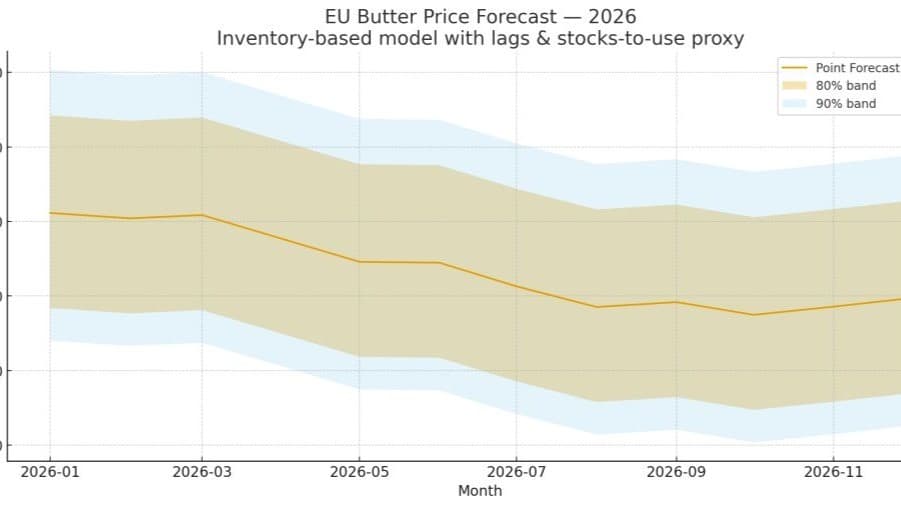
Summer Shopping or Summer Sale?
Last week was again a bit of a bearish week for the entire dairy industry. With cream prices under pressure and milk intake still strong, we keep seeing a market that has more supply than demand. Butter prices took another step lower, cheese prices cracked, and the powder market gave back a bit of its gains again.
The weekly report
Get it before it is anywhere else
Every market report, straight to your inbox the moment it is written. Butter, cheese, powder, liquids — pick what you actually trade.
Roughly weekly · Free · Unsubscribe any time