Lessons From 2022

Lessons from 2022
Supply and demand are the fundamental determinants of market prices. With supply tightening, it's unsurprising that prices are rising. A similar pattern emerged in 2021/2022 when milk supply was particularly poor in the second half of 2021. At the same time, high input costs (energy, feed, and fertilizer) provided little incentive for farmers to boost production. It wasn't until prices hit 60 cents and above that EU milk intake significantly increased, causing prices to ease about 12 months after they began rising.
In 2022, we saw Gouda prices climb to €5,300, butter to €7,500, and SMP to over €4,000. Despite concerns that these high prices would reduce demand, strong government spending and cheap money kept consumers buying. In the EU, there was no significant demand destruction. While retail demand for butter may have dipped slightly, a review of consumption data reveals that demand only visibly declined after prolonged high prices.
High Prices for an Extended Period
In 2022, butter prices remained above €7,000 on quotations from March to October (8 months) before they began to fall. Gouda prices stayed above €5,000 during the same period, and cream prices traded above €8,000. SMP prices broke above €3,500 for the first time in January 2022 and only fell below this level at the end of October, nearly 10 months later. We had similar discussions with our partners at the time about how these high prices might curb demand.
Supply Impacts Price More Than Demand
Ultimately, it wasn't declining demand that brought prices down at the end of 2022 but the rapidly increasing supply. From September 2022 onward, EU milk collections grew by more than 1%, easing concerns about product availability. Looking back, it appears that dairy commodity prices are more influenced by supply than demand. And it's this same supply problems that make us so bullish on the rest of 2024. Based on discussions with producers and data analysis, it seems unlikely that the current supply issues will be resolved quickly.
Outlook on Supply Issues in 2024
Currently, supply issues in the EU are unlikely to improve in the coming months. Milk production in Western Europe is under pressure, and there are growing concerns about how bluetongue will exacerbate the already tight supply. Due to an extremely wet start of the year, the grass quality is poor and the effects are seen in the milk intake and thickness of the milk. Speaking to farmers, at the current milk payout prices, feeding to compensate isn't always interesting. More milk in the EU is doubtful in our opinion.
The most immediate relief may come from outside the EU, particularly for the butter market, where there is interest in bringing in Australian and New Zealand products. For cheese and SMP, we don't anticipate significant sourcing from outside the EU. Instead, outlet destruction may occur due to heavy competition from other regions. However, we doubt the U.S. cheese market will pose much competition looking at the recent price rally seen there.
The SMP market is a bit different. With cheaper SMP/NFDM from the U.S. and a weaker dollar, many EU partners are reportedly losing business to U.S. suppliers. The broader powder segment of the dairy commodity market is seeing a shift in sentiment. WMP prices have risen quickly, and whey prices have also increased. SMP prices have been relatively stable for two years and may break out of this trend.
It's crucial to closely monitor EU milk intake in the coming months. While high prices may slightly impact demand, we believe the effects will be minimal over the next four to six months. The market demonstrated in 2022 that commodity prices equivalent to 60 cents for milk can be sustained for a extended period. The idea that current prices, which have been in place for only two weeks, could quickly drop seems unlikely. An old adage among experienced traders is "What goes up fast, comes down even faster," which holds true in our opinion if a rally is driven mainly by sentiment. However, the current price rally feels more fundamentally driven. Therefore, we suggest introducing a new phrase:
"What goes up on fundamentals can only go down on fundamentals."
More from the desk
Our Long View Before Our Long Break 
Our Long View Before Our Long Break
Last week the market found a bit of stability. After lower trades on cheese, the cheese market traded slowly up, although a real rally remains absent. Butter prices did dip a bit further, although at the start of this week we see some strength on the back end of the curve. And on powder, our bullish feeling just doesn't go away — and now we can find some confirmation in the market as well.
Dairy Carry Has a Shelf Life 
Dairy Carry Has a Shelf Life
Last week was bearish across the board — every product we broker leaned the wrong way. Powders lost more momentum, cheese slipped well below €3,000 for some products, and butter continues to impress with just how much keeps showing up. Supply, supply, supply.
Summer Shopping or Summer Sale? 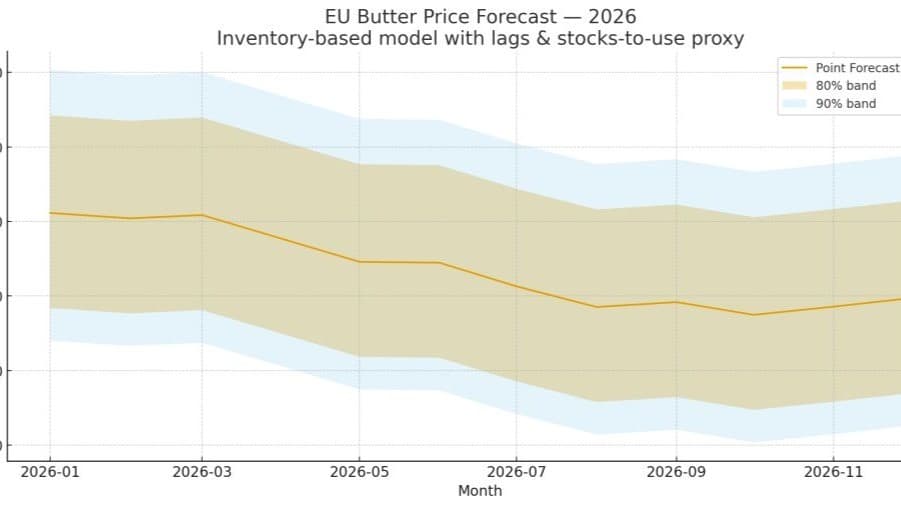
Summer Shopping or Summer Sale?
Last week was again a bit of a bearish week for the entire dairy industry. With cream prices under pressure and milk intake still strong, we keep seeing a market that has more supply than demand. Butter prices took another step lower, cheese prices cracked, and the powder market gave back a bit of its gains again.
The weekly report
Get it before it is anywhere else
Every market report, straight to your inbox the moment it is written. Butter, cheese, powder, liquids — pick what you actually trade.
Roughly weekly · Free · Unsubscribe any time