(Leaving Dublin) Uncomfortably Bullish

Last week, we were on the road in Dublin, meeting many familiar faces from the dairy industry. For three days, we immersed ourselves in dairy discussions, accompanied by some not-so-dairy-related drinks. Conversations centered on managing risk to avoid financial headaches, even as we risked a different kind of headache the next day. A big shout-out to the StoneX team, who hosted a high-quality three-day seminar with excellent panelists, speakers, and presentations, ensuring everyone felt welcomed, informed, and well taken care of. We arrived in Dublin with a firm view on the dairy market, only to leave feeling even more confident—albeit uncomfortably bullish, a sentiment shared by many of our industry partners.
What Does Uncomfortably Bullish Mean?
Defining “uncomfortably bullish” proved challenging. Are we worried that the market will soon decline? Not really. Do we think current prices are unmanageable for the industry? Perhaps slightly, but not entirely. Or is it simply that widespread bullishness among partners hints at a potential reversal? Again, no. Yet, when asked if we would buy forward at these high prices for butter and cheese, our answer remains no. There is a discomfort in buying at these levels that we and our partners share. Should we disregard this feeling, or heed the inner voice advising caution?
More Milk Due to High-Profit Margins?
One key reason to delay buying is the expectation that high prices will quickly drive up the milk price paid to farmers, incentivizing increased production. This topic was heavily debated at the StoneX event. While higher profits typically push milk production, we believe that, unlike in the US, EU farmers are slightly less responsive to financial incentives.
Environmental Constraints and Succession Challenges
EU milk production faces significant pressure. In some countries, farmers are viewed not as food production heroes but as environmental polluters. The year-round demands of dairy farming are often undervalued, both by the public and policymakers. Recently, the Dutch Minister of Agriculture announced that reducing the Dutch cow herd is inevitable, which follows a trend of declining Dutch milk intake. Successors taking over Dutch farms are now limited to inheriting only 70% of animal rights, complicating farm succession and discouraging expansion.
This succession issue extends beyond the Netherlands. In France, many farmers are retiring without successors, and while French milk intake is slightly better than last year, a clear downward trend persists that higher payout prices are unlikely to reverse. Irish partners echoed similar concerns, highlighting environmental issues and challenges in finding workers. While Eastern EU countries may see growth as milk prices rise, similar problems are felt in Denmark, Germany, and Belgium.
A Negative Curve
Another major discussion point in Dublin was the negative forward curve. While current high commodity prices may temporarily boost payouts, the negative curve suggests these prices won’t last. Without expectations of sustained high payouts, EU farmers are unlikely to significantly increase production, aside from small feed adjustments. Should the EEX futures curve flatten through 2025 (on the Q4 commodity price levels), higher prices could encourage farmers and cooperatives to lock in, offering a more positive long-term outlook.
Rising Costs
Farm profitability hinges on the payout price and feed costs. Though feed costs are relatively manageable, other expenses have risen significantly, especially labour, interest rates, and manure disposal costs. The critical question is: At what milk price will farmers feel compelled to increase production? While low-cost producers are already profiting at 52 cents, most partners expect substantial milk output to kick in around 58-59 cents, provided prices remain stable for another 3-4 months.
Overall Supply/Demand Balance
The data presented last week painted a bullish picture. Low stocks are driving bullish sentiment, compounded by uncertain milk intake forecasts for August and beyond. Bluetongue disease impacts are already evident and appear more severe than expected, suggesting the milk intake for the remainder of the year will be weaker than anticipated, further unbalancing the supply/demand curve.
Recent German data shows a -2.2% reduction in milk collections and roughly 7% less butter production compared to last year, highlighting a tightening supply. Cheese production, strong earlier this year, is now slowing. With demand rising, the supply/demand balance is shifting quickly.
Demand Concerns
While low supply is undisputed, demand remains a key uncertainty. Supply data is (fairly) timely, but demand data often lags, forcing reliance on anecdotal evidence. So far, demand remains robust, with end users calling off quarterly volumes early in hopes of lower prices later. No significant consumer reaction to higher prices has been noted yet, but many expect that German households, in particular, will respond quickly once confronted. However, we suspect that significant changes in consumer behavior won’t occur until early next year.
Import & Export Impact
The discussion on import/export dynamics during evening drinks revolved around two key points: “We won’t export at these prices,” and “NZ products will ease pressure on the EU market.” While some NZ and Australian butter shipments are en route to the EU, these will likely arrive in late December or early Q1, leaving the impact uncertain. With butter prices exceeding €8000, importing NZ product makes sense, but long-term pricing around €7000 raises questions about the volume.
Exports, on the other hand, are expected to decline. Traditional export markets like Morocco, Turkey, and Ukraine are unlikely to buy at these high butter prices. While exports to the US and Canada should remain stable due to preferences for Irish butter, cheese exports are also likely to decrease, with some North African buyers still able to meet the higher prices.
Powder exports are expected to increase, as EU products are currently the second cheapest on the global market after NZ. With Ramadan approaching earlier next year, we anticipate strong powder demand over the next three months.
Market Outlook
Overall, we see little reason to be bearish. Prices have room to rise further, with commodities like SMP, WMP, BMP, and SWP still far from their all-time highs. Cheese prices, though still 10-20% below their peak, are less comfortable to buy given the equal downside risk. We recommend cautious buying into 2025, particularly with cheese, where once milk intake recovers, prices may normalize. Finally, we remain hesitant on our butter advice, despite its fundamentally bullish outlook: low stocks, no production incentives, and strong demand. As everyone fears buying butter despite acknowledging its bullish fundamentals, we could see prices reach new highs in the coming months.
More from the desk
Our Long View Before Our Long Break 
Our Long View Before Our Long Break
Last week the market found a bit of stability. After lower trades on cheese, the cheese market traded slowly up, although a real rally remains absent. Butter prices did dip a bit further, although at the start of this week we see some strength on the back end of the curve. And on powder, our bullish feeling just doesn't go away — and now we can find some confirmation in the market as well.
Dairy Carry Has a Shelf Life 
Dairy Carry Has a Shelf Life
Last week was bearish across the board — every product we broker leaned the wrong way. Powders lost more momentum, cheese slipped well below €3,000 for some products, and butter continues to impress with just how much keeps showing up. Supply, supply, supply.
Summer Shopping or Summer Sale? 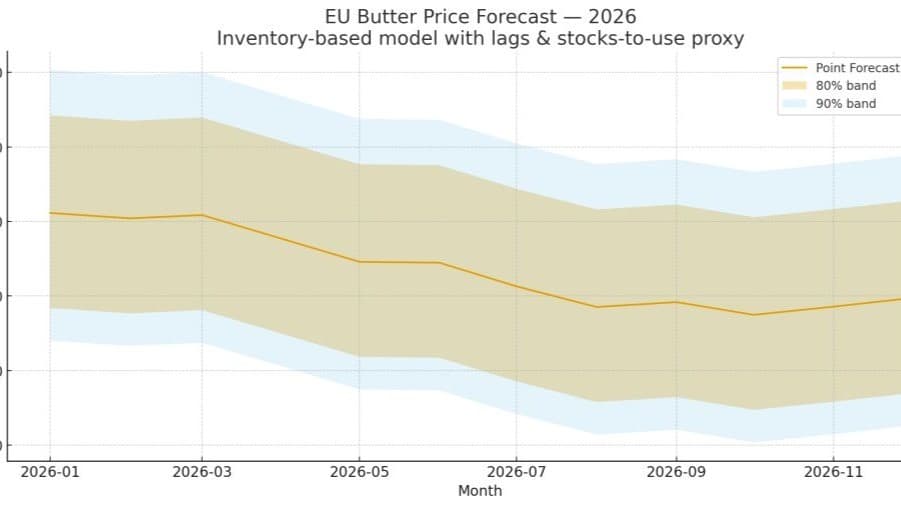
Summer Shopping or Summer Sale?
Last week was again a bit of a bearish week for the entire dairy industry. With cream prices under pressure and milk intake still strong, we keep seeing a market that has more supply than demand. Butter prices took another step lower, cheese prices cracked, and the powder market gave back a bit of its gains again.
The weekly report
Get it before it is anywhere else
Every market report, straight to your inbox the moment it is written. Butter, cheese, powder, liquids — pick what you actually trade.
Roughly weekly · Free · Unsubscribe any time