How A Few Impact Many

Last week was again a busy week, filled with volatility in cheese and butter and a steady trend in powders. The activity over the last few weeks seems to be slowing down a bit, not only through our services but in general. Speaking to many partners, they see the same as we do: fewer transactions and smaller quantities per transaction. The market is remarkably thin, with little available volume on both the sales and purchase sides. But what strikes us most is that there is only a handful of active players willing to transact in this market. A thin market, played on by only a few, is showing us incredible volatility as we have never seen in our ten-year dairy career. With the market being more transparent than ever due to futures, broker platforms, and information platforms reporting on daily and weekly price changes, the actions of a few affect the prices for many of their market peers.
As long as we have worked in dairy, we have always heard the phrase, "It's traders influencing the market." The biggest names get mentioned the most, and the Dutch trading houses in particular. Having worked for a midsized trading house, I have always felt the influence of trading houses on the market is very marginal. Even the biggest trading houses only trade a fraction of the total yearly volumes the EU produces as a commodity. Moreover, most trading houses are well-managed in terms of risk management, allowing them to have only limited exposure to market changes. But as volatility rises, discussions about traders' influence on the EU dairy markets light up. Last week, we again saw price swings up and down, with frustration from producers and end-users resulting in feedback like, "We are not participating in this trader’s game; they artificially keep prices high," and "The traders are destroying the margins of the farmers by pushing prices down." Both rising and falling prices are blamed on traders' activity. The question we had is: is this true? And if so, is it fair to blame the traders?
Transparency and Visibility
First of all, the market has changed a lot over the last ten years. With trading/brokerage platforms like GDT, NUI, Get Fair Dairy, and Dairy 4 Business, the market has become much more transparent. Within an hour after the GDT ends, the whole market knows what prices traded. And with brokerage platforms like ours, activity sometimes gets known to the market within minutes. Although our initial idea was that this would create a more level playing field, it does more than that. A new market trade, no matter the size, seems to have a direct impact on the attitude of buyers and sellers in the market.
Over the last few years, the use of futures has also grown rapidly. Where 10 years ago EEX dairy futures were only used by a few, now it seems every company at least has some basic understanding of the instruments available. More importantly, both buyers and sellers follow the information and know exactly where futures are priced for the products they buy or sell. And although some complain about the volatility on EEX futures, they all reference it if it suits their negotiation. If it doesn’t, they dismiss the instrument quickly as a “secondary” market. We see it during our trading days: a change in futures prices immediately changes the bid/offer spread we have on the physical market. There are only a few “old-school” partners left who build their price expectations purely on fundamental analysis of supply and demand.
Lastly, the available market information via market platform tools is also growing and becoming more relevant. Vesper’s VPI has a major impact on price negotiation. The same can be said about the information available on StoneX Plus and in reports from others. It seems stakeholders in the industry are much better informed and have much more up-to-date data at their disposal. Being more transparent and having more visibility on day-to-day price changes does give the broader field in the market a more level playing field, we are sure. But it’s that level playing field that’s creating the increased volatility.
Buyers and Sellers Waiting for Extremes
I feel old when I say, “back when I was a trader,” but… Back when I was a trader, information travelled slower. (and before I became a traders, probably even slower) Being in front of the market with the freshest information first is what gave traders an edge over their counterparts. On the basis of that information, it was possible to act 2-3 days before the market realized the same thing, and sometimes even longer. That timeframe has shrunk dramatically, giving traders less time to act on the information and pushing them to be more aggressive in taking the business. But that aggressive form of buyin/seller is not the only thing that has changed now information travels quicker.
Because we have seen many times over the last few months, is the reaction from both the buyers' and the sellers' side as soon as the market moves in their favour. Sellers tend to up their sales levels after every sale they make and sometimes even if they see higher trades (via brokers or on futures). If the market moves more than € 200, sellers completely step out, needing to reassess their market outlook, taking out more liquidity and making the market thinner. We have seen the market move up €400-€600 in one week as producers revise their sales prices by the hour before disappearing completely. Such fast and strong increases are something of the last few years.
The same trend can now be seen on the buyers' side. As markets weaken, buyers are stepping away from their purchasing seats. Not only is it a good strategy to avoid buying too much in a falling market, but it also feels a bit like payback time for many buyers in the market. Of course, this waiting-for-the-bottom strategy was commonly used 10 years ago as well. But 10 years ago, these buyers needed to dip their toes in the water every week and see where sellers would sell by bidding the market down a bit each week. Due to the higher transparency, now they don’t need to do this themselves. They can simply watch the futures, follow broker market updates, or wait for the weekly benchmarks to come out.
This stepping away from the market leads to two things: a much thinner market and much higher volatility. We saw it last week on the butter side, where futures dropped over €400 on Monday, only to rise back up by Tuesday at the end of the day and drop back down by the end of the week. Although the total volumes might have exceeded a little over 2000mt in total trades, these are relatively small volumes compared to the total production in that period of butter.
Many Leave It to the Few
With many market participants happy to watch the market volatility play out from the sidelines, a few participants are willing to trade every day—the traders! Unlike sellers and buyers, traders are not in the market to sell at the top or buy at the bottom; they are there to trade opportunities. Unlike an end-user or producer, the trader wants to buy and sell something every day and optimize their books. They come to the market with a “what can we do” mentality even if the producers and end users have stepped away. Both the market on EEX and the market via the brokers (where traders trade with traders) provide opportunities, even if the traditional market doesnt.
So yes! Traders do cause the majority of the activity at the moment in the market that is visible for us to see and report on. And with such a thin market, their activity gets amplified more than it does in a market with more participants. And do they sometimes know the current market dynamics give them a bit more influence? It would be naive to think they don’t. The question is, how should the market cope with this? The transparency and visibility of trades will not disappear, and the instruments to manage risk will only grow in use.
To balance the power of the few, many more market stakeholders should have a more active presence in the market. A market with more depth will take out the big swings in the market. It doesn’t mean that volatility will disappear. The ever-changing dynamics between demand and supply can still create surpluses and shortages, creating new highs and lows. But the influence of a few will get smaller, and the impact of the many will be greater.
More from the desk
Our Long View Before Our Long Break 
Our Long View Before Our Long Break
Last week the market found a bit of stability. After lower trades on cheese, the cheese market traded slowly up, although a real rally remains absent. Butter prices did dip a bit further, although at the start of this week we see some strength on the back end of the curve. And on powder, our bullish feeling just doesn't go away — and now we can find some confirmation in the market as well.
Dairy Carry Has a Shelf Life 
Dairy Carry Has a Shelf Life
Last week was bearish across the board — every product we broker leaned the wrong way. Powders lost more momentum, cheese slipped well below €3,000 for some products, and butter continues to impress with just how much keeps showing up. Supply, supply, supply.
Summer Shopping or Summer Sale? 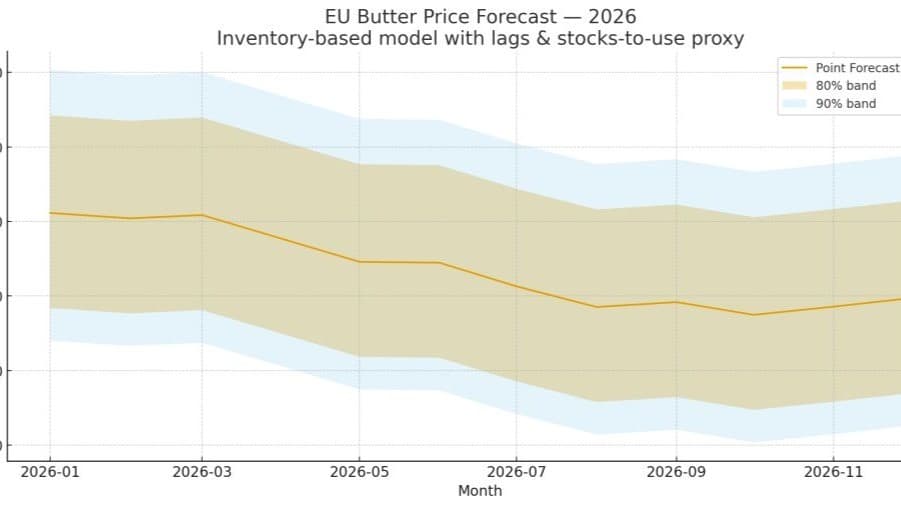
Summer Shopping or Summer Sale?
Last week was again a bit of a bearish week for the entire dairy industry. With cream prices under pressure and milk intake still strong, we keep seeing a market that has more supply than demand. Butter prices took another step lower, cheese prices cracked, and the powder market gave back a bit of its gains again.
The weekly report
Get it before it is anywhere else
Every market report, straight to your inbox the moment it is written. Butter, cheese, powder, liquids — pick what you actually trade.
Roughly weekly · Free · Unsubscribe any time