Herd Volatility

The butter market hit new highs again yesterday. After a significant correction on Monday and Tuesday, butter prices have rebounded over the past two trading days. Cheese also feels firmer, EEX futures continue to show strength, although buyers on the physical market are about a month behind on their butter pears. Many cheese buyers remain skeptical, doubting the sustainability of these higher prices for the coming months, and have maintained a hand-to-mouth buying strategy. However, with a tight spot market for milk and cream, elevated butter prices, and a high-demand season still largely uncovered, cheese buyers may soon face the same harsh realities as butter buyers. But the hope for a correction is strong. As former traders, we know that relying on hope is not a strategy — it has no place on the trading floor. Meanwhile, amid the volatility in the butter and cheese market, the powder market has been steadily climbing, gaining a few cents each day.
"Hope belongs in church or on the toilet, not on my trading floor!"
We don't mean to offend anyone, but this saying has taught us a lot. Trading isn't an exact science, and predicting commodity prices for butter, cheese, and powder a year from now is impossible. We acknowledge that a degree of anticipation and speculation is necessary in the dairy market. However, in the last three weeks since returning from our summer break, we've heard phrases like "we hope for the best" or "we hope the market settles down" far too often. We see many of our partners struggling, almost paralyzed to act in this market. And although we understand the difficult decisions faced by our partners, it feels like the window of opportunity to act is shrinking rapidly.
We've been on the wrong side of a trade ourselves many times in our careers, and it's easy to hold onto little pieces of information that supports your position. However, the hardest part is stepping back and considering the full market dynamics. In the past few days, we've seen too many buyers waiting for a cheaper offer, but when presented with an opportunity, they step back, hoping prices will fall further. Now, those same buyers are watching the market climb again, chasing the offers they initially rejected.
Herd Mentality Drives Volatility
As the market becomes more transparent, many participants are reaching the same conclusions simultaneously, causing them to walk around the market in a herd. And let's be honest, following the herd feels safer, even if it means paying higher prices or making suboptimal decisions. One partner summed it up perfectly:
"If you walk ahead of the herd without looking back, you risk being alone and vulnerable. But if you walk behind, all you do is trudge through the shit left behind by the ones in front of you."
This herd mentality has amplified volatility. When buyers enter the market simultaneously, prices spike quickly. Conversely, when buyers step out and sellers get anxious, prices can drop faster and deeper than necessary. However, market sentiment alone does not determine supply and demand — it's the underlying data behind production and consumption that truly matters. While calculating the S/D curve for dairy is complex, it's essential to keep an eye on the bigger picture.
The Bigger Picture
We’ve shared enough reports recently outlining our views on the overall dairy market. The challenge is that the hard data we have is historical, providing explanations for past price movements but limited insight into future trends. Unforeseen events, like the recent bluetongue outbreak, are impossible to predict, underscoring the importance of risk management in today's market. Key trends we see for each segment are:
Butter:
- Butter stocks are at their lowest in the past decade.
- Cream prices remain high, constraining production as fresh demand pushes prices close to or above €10,000.
- Many end-users have significant uncovered positions based on their request for quotations.
- Producers hold minimal stocks due to high prices and financing costs, which discourage inventory.
- Traders hold minimum positions due to the high risk a small exposure to these prices brings.
- Buyers of winter butter for next year need to recognize that without paying a premium for Q2/3/4 over Q1, there will be limited butter availability. No trader or producer will stock and finance butter with a negative carry.
Cheese:
- Prices are firming globally, with strong worldwide demand.
- Cheese production in the EU is down, with producers reporting reduced output in recent months.
- A large number of end-users have substantial uncovered positions based on their quotations.
- Cheese prices need to remain high to compete with butter for milkfat.
- Mozzarella is currently the most profitable cheese to produce, which will likely push up prices for other cheeses like Gouda and Edam.
Powders:
- Internal EU demand is picking up.
- Export prices are rising, but the EU is not yet competitive.
- Producers have little to no stock and can only offer fresh product starting at the end of October.
- High SMC prices do not justify high SMP production.
- Reduced cheese production could push whey prices higher.
More from the desk
Our Long View Before Our Long Break 
Our Long View Before Our Long Break
Last week the market found a bit of stability. After lower trades on cheese, the cheese market traded slowly up, although a real rally remains absent. Butter prices did dip a bit further, although at the start of this week we see some strength on the back end of the curve. And on powder, our bullish feeling just doesn't go away — and now we can find some confirmation in the market as well.
Dairy Carry Has a Shelf Life 
Dairy Carry Has a Shelf Life
Last week was bearish across the board — every product we broker leaned the wrong way. Powders lost more momentum, cheese slipped well below €3,000 for some products, and butter continues to impress with just how much keeps showing up. Supply, supply, supply.
Summer Shopping or Summer Sale? 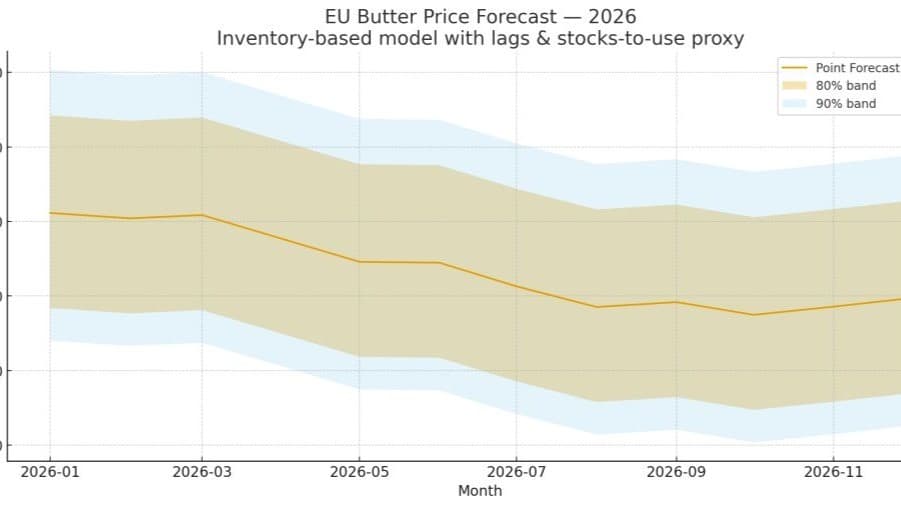
Summer Shopping or Summer Sale?
Last week was again a bit of a bearish week for the entire dairy industry. With cream prices under pressure and milk intake still strong, we keep seeing a market that has more supply than demand. Butter prices took another step lower, cheese prices cracked, and the powder market gave back a bit of its gains again.
The weekly report
Get it before it is anywhere else
Every market report, straight to your inbox the moment it is written. Butter, cheese, powder, liquids — pick what you actually trade.
Roughly weekly · Free · Unsubscribe any time