Gap between Fat and Proteins widens.

Yesterday, market activities mirrored those of the preceding days. The cheese market remained notably inactive, while powder prices continued their downward trend. Butter prices experienced a morning dip but rebounded in the afternoon. Globally, protein prices exhibited a consistent decline, with SGX, CME, and EEX futures trading lower following a weaker GDT Pulse event. In the European market, fat prices continued to rise, contrasted against the persistent decline in protein prices. This prompts the question: could there be an excess of protein and a shortage of fat?
Market prices find balance through the interaction of supply and demand. The supply side is shaped by the integration of existing stock levels and new production volumes. On the other hand, consumption and stock building from end-users dictate the demand side. While the consumption aspect is often challenging to decipher, it appears that consumer consumption tends to grow steadily each year, market consumption is determined more by strategies chosen by purchase managers. Consequently, the supply side holds greater significance in determining market prices. Let's delve into the supply-demand balance for all products:
The Cheese Ballance: More Production More Competition.
Examining the cheese market, we've observed a consistent increase in the number of cheese factories. Despite the initially low cheese stock in the EU, there seems to be no imminent pressure building up. In Europe, additional mozzarella plants have been established, Aware is starting up its latest Gouda plant in Ireland, and Eastern Europe is witnessing a surge in cheese production. The United States is following a similar trend. Consequently, it's highly probable that more milk will be directed towards cheese production compared to previous years.
These cheese factories are not only fighting for a local market share but are also actively seeking opportunities in export markets. Regions like the Middle East, North Africa, Japan, and Korea are witnessing competition among products from the US, EU, and NZ for a share of their markets.
However, in these regions, cheese is not as commonplace in daily diets as it is in the EU and the US. It holds a special rather than ordinary status, and demand is more susceptible to the economic conditions of a country. Less economic growth has a higher impact on consumer dairy consumption.
Viewing the cheese market through an EU lens, we note the following:
- Increased production capacity suggests a potential rise in supply.
- Stronger competition from the US and NZ may result in reduced EU exports.
- With an anticipated surge in EU milk production during the peak period, we expect full capacity utilization in April/May.
- Steady EU demand is anticipated to provide a support level for the market.
Given these factors, our outlook for the cheese market is bearish, with the highest price pressure expected in Q2.
Powders: A story of many lows
The powder market continues to be characterized by many different lows. Assessing the EU stock position reveals one of the tightest markets in recent years. A similar situation is evident in the US. It's not surprising that most partners have been, or still are, bullish about the powder market. Furthermore, there's an indication that more milk will be directed toward cheese/whey production, reducing the availability of milk for butter/skimmed milk powder (SMP) production. Normally, these conditions would favour an increase in SMP prices, particularly with New Zealand going out of season.
However, the significant impact of the low-demand side of the market becomes apparent in this scenario. It appears that both producers and traders, as well as buyers, have been anticipating higher prices. The largest stocks are seemingly held in China and Southeast Asia, and given that major buyers in the market only make purchases when prices are low, it may take some time for the market to show a substantial upward movement.
Nevertheless, we believe the market may not experience a significant further drop, as buyers continue to accumulate stocks when prices reach lower levels. In summary, regarding the powder market:
- Low stocks in the EU and US
- Low production in the EU and US
- Low prices for skimmed milk powder (SMP) in the EU, making additional production more likely
- Low demand from export destinations
Our outlook remains bearish, with limited potential for further downward movement.
Butter: Bullish Fundaments
Examining the butter market, we observe significantly lower stock levels compared to previous years, both in the EU and the US. Furthermore, butter production in the EU in the initial months of this year lags behind last year's figures, indicating a slower replenishment of stocks compared to previous years. Additionally, Ireland is experiencing a delayed start to its milk season, with a reported deficit of -6%. This delay is notable as Ireland typically contributes a substantial amount of butter around this time of the year.
The deceleration in stock building in the EU (and US) appears to stem from an increased allocation of milk to cheese production, as mentioned earlier. Despite the better valorization of butter/SMP compared to cheese, it seems that newer factories are prioritizing cheese production over butter. Globally, butter prices remain high, although the EU, at its current prices, may not be the most appealing option for buyers. Nonetheless, we continue to hear reports of robust exports from the EU.
The demand outlook for butter is uncertain, with varying opinions among our partners. Some anticipate that buyers have already secured the majority of their needs, while others foresee low coverage. Conversations with end users suggest that many are still speculating on lower prices, indicating a reluctance to make purchases.
Looking specifically at the butter situation in the EU:
- Lower stocks compared to previous years
- Reduced production compared to previous years
- Anticipation of more milk going to cheese, hinting at lower butter production in the coming months
- Challenges in exporting at current prices, with imports appearing unlikely
- Buyers are waiting for lower prices, indicating uncovered demand
Our outlook for butter is therefore bullish. Despite the prevailing high prices, we anticipate the market to trade even higher unless there is a swift diversion of more milk to butter production.
More from the desk
Our Long View Before Our Long Break 
Our Long View Before Our Long Break
Last week the market found a bit of stability. After lower trades on cheese, the cheese market traded slowly up, although a real rally remains absent. Butter prices did dip a bit further, although at the start of this week we see some strength on the back end of the curve. And on powder, our bullish feeling just doesn't go away — and now we can find some confirmation in the market as well.
Dairy Carry Has a Shelf Life 
Dairy Carry Has a Shelf Life
Last week was bearish across the board — every product we broker leaned the wrong way. Powders lost more momentum, cheese slipped well below €3,000 for some products, and butter continues to impress with just how much keeps showing up. Supply, supply, supply.
Summer Shopping or Summer Sale? 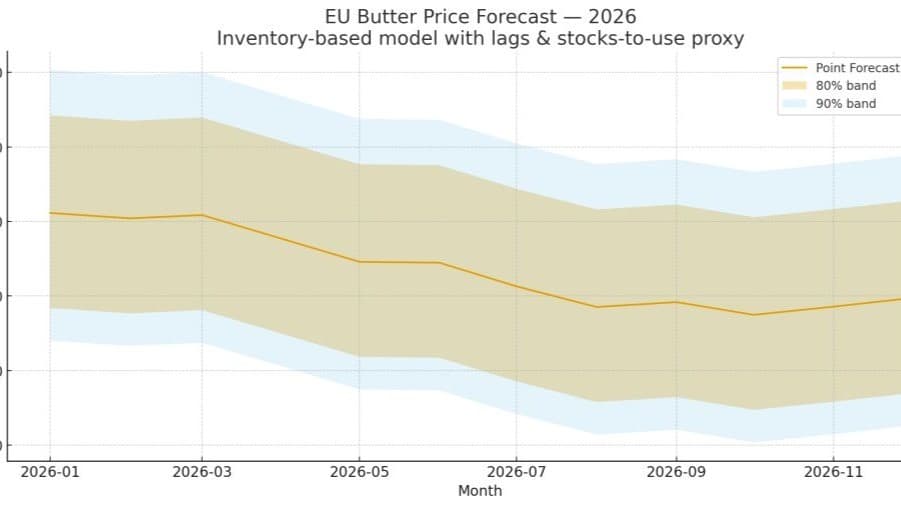
Summer Shopping or Summer Sale?
Last week was again a bit of a bearish week for the entire dairy industry. With cream prices under pressure and milk intake still strong, we keep seeing a market that has more supply than demand. Butter prices took another step lower, cheese prices cracked, and the powder market gave back a bit of its gains again.
The weekly report
Get it before it is anywhere else
Every market report, straight to your inbox the moment it is written. Butter, cheese, powder, liquids — pick what you actually trade.
Roughly weekly · Free · Unsubscribe any time