
Too Much Milk, Not Enough Market

This week the commodity markets feel heavy across every product we broker. Pressure on spot liquid markets is translating directly into selling pressure from producers — but most buyers didn't wait. They covered via another route, earlier, and at better levels. This market feels very one-sided. Not just on Q2 — on Q3 the sales side feels significantly heavier than the buy side, and there is no clear catalyst to rebalance it. Historic statistics don't offer much comfort to sellers. All key metrics point to lower prices — and not close to today's levels, if we had to guess.
A quick note: GFD will be taking a two-week break from Monday. For the update addicts — just re-read this one every morning. We expect it to cover the sentiment for at least the next 14–20 days.
Liquids: More & More
Milk intake across western EU remains elevated. All data we can find points to increases of between +2% and +7% YoY — meaning the EU needs to balance more milk than it has ever had to before. The pressure this creates is unprecedented in recent history.
Cream took a notable nosedive this week. Levels are now reported between €3,400 EXW and €3,700 DAP. At €3,700 DAP, producers can manufacture butter at a cost price of roughly €3,400–3,500 — leaving margins razor-thin or negative depending on origin and efficiency. SMP prices are also under heavy pressure, dropping from last week's €1,500+ back down to €700–900. Raw milk is barely holding above €0.10/kg across western EU, and in France it appears to have slipped back below that level again.
There is hope — and it is not unreasonable — that the fresh season takes some pressure off. Ice cream, fresh fruit with cream, summer demand: these things historically do lift cream prices after Easter. But don't expect a fast recovery.
We went back through the last 10 years of cream data with our data tools and the pattern is clear. In bullish butter years — 2017, 2018, 2024 — cream recovered quickly, within 1–2 weeks of Easter. In 2022, a structurally weak butter year, cream continued to drift lower post-Easter and never reclaimed Easter levels within 16 weeks. The average recovery across all years takes 4–5 weeks. Based on that history, cream trading back around €3,800–4,000 by mid-May is the optimistic expectation — not a straight line there, and not without further volatility. Until then, the spring milk flush will continue to pressure the market.

Last week's data added an important data point. Cream spiked to €4,200 in the week following Easter — a sign that latent demand might exist. It then gave back €600 in a single week, closing at €3,600. A spike that cannot hold is not a recovery signal. It is a selling signal. The market showed its hand: buyers exist at €4,200, but not with enough conviction to absorb the supply behind them.
All spot liquids expected to trade weak. If cream is any kind of leading indicator — and historically it is — expect weakness to continue throughout Q2, pushing more cream toward butter production, dryers, or cheese facilities. The chart below shows the bull, base and bear scenarios we modelled from the data.

Not to be lazy, but the tools we use give pretty good convincing arguments; we thought we would share them with you all in the words of Claude, our best friend and data analyst, whom we, as a small company, can wish for.

A note on how we use data
We have worked with our data tools for several months now, and we are aware of a real risk: feed a system bearish inputs systematically, and it will confirm a bearish view. That is not analysis — that is bias with a chart on top of it. And although we know AI can't do the job of a broker, it can really assist in putting large datasets into context as an analyst. And where for us as a broker its very difficult to put our bias aside, it is easier to remove the AI's bias.
That is why we ran this dataset in a clean environment, without pre-loaded history or directional framing, and asked it to work from the numbers alone. It still came back bearish on fat. But we want to be transparent: we are sharing the same dataset and the same methodology. If your analyst looks at this data and reaches a different conclusion — we genuinely want to hear it. Markets are made by people who disagree.
Butter: The 2027 Bids vs. the 2025 Stocks
Let the cream market be the cream market. Let's talk butter. Butter took another dive yesterday. May–June NL/DE/BE traded down toward €3,800. Polish Lactic moved below €3,700. Some of the less optimal Polish brands were offered between €3,500 and €3,550 FCA Poland for April collection. The forward curve stepped lower with it — Q3 trading at €4,050, and July through December dealt as low as €4,100.
Futures also moved lower, but quotations proved once again exactly why EEX futures have been trading at such a significant premium to reality. French butter quotations went — up. In a market where every traded line pointed toward €4,200, the French quotation went up. The German quotation did fall, toward €4,175. Even the Dutch held at €4,100. We won't continue our quotation-bashing much longer — but with physical trading €400 below the average quotation, the market is operating with a broken risk management tool. That needs fixing, and it needs fixing badly.
With cream pressure mounting, we expect butter prices to drop below €4,000 across the full 2026 curve. A quick round of calls made that point very clearly. Almost all major end users claim to have covered more than 90% of their 2026 needs — with many already locking in large volumes of 2027. Meanwhile, a round of calls on the production side tells the opposite story: almost no producer has started selling July onwards production, and the Q3 offers currently circulating are largely for frozen butter, 2026 production.
And then there is this: some traders are still receiving offers on 2025 production butter — and using it to hedge against 2027 forward contracts they have already sold. Admittedly, that butter won't physically survive until June 2027. But it tells you everything about how far this market is stretching its stocks. The gap between where buyers have contracted and where producers are willing to sell has never been wider. Someone is wrong. Our analysis suggests it won't be the buyer this time.
Cheese: The Additional Sales
A brief look at the cheese market.
A few weeks ago we told you €3,600 was the price for everything. Today that number has shifted to €3,450. Cheddar, mozzarella, Gouda, Edam — all offered around €3,450. Bids are absent, though in fairness that may partly reflect a lack of time on our side to connect these markets properly. Butter and powders have consumed most of our attention this week, and the cheese market continues to show the same pattern we keep seeing: either a buyer or a seller — rarely both in the room at the same time.
We did manage to speak to a few extra partners today, and the consensus was consistent. The Q1 rally was driven by producers who were oversold, exports to have exceeded expectations and buyers who expected easy availability. Both were wrong in the same direction, which is what created the move. Q2 and Q3 look like the mirror image: traders positioned for tight markets, producers who have been underselling, and buyers who — so far — feel very comfortable. No urgency, no fear of missing out, no covering pressure.
Cheese is not as bearish as butter. But we cannot use the word bullish to describe this market either.
The variable that changes the picture is export demand. If the right export deals get done quickly, there is a floor here. If they don't, the direction is clear — expect cheese to drift further from €3,500 and closer to €3,300. The window to stop that move is open, but it won't stay open indefinitely.
Powders:
Powders came to a standstill at the start of the week, with very limited activity. Today some movement returned — 200 MT French SMP MH (April–May) traded at €2,625 FCA FR. The overall tone remains nervous and directionless. There is still a broad conviction that prices could move higher once export demand comes through, particularly given the significant price gap between EU and other origins. But that move is taking time. Export buyers have a long breath, and for several weeks now volumes are simply not being actively picked up. Meanwhile, SMC prices are putting the dryers at full capcaity, creating the highest SMP production in years in the EU.
The geopolitical situation in the Middle East continues to constrain demand — not from a consumption perspective, but from a supply chain one. Freight disruptions, counterparty risk and regional instability are limiting flows. On top of that, regional redistribution channels from the Middle East into Africa are under pressure, which slows the system further and removes what would otherwise be a reliable layer of demand.
SEA tells a slightly different story. Demand is structurally present, but buyers are waiting. With flush-driven supply, early oversupply signals, and a quieter Middle East backdrop, the expectation is building that prices will come to them. They can afford to be patient — and they know it.
The structural support from absent US powders remains real. Each time CME trades limit up, EEX follows and physical offers move €100 higher in response. But that transmission is one-directional right now — it lifts offers without lifting bids. The futures market and the physical market are speaking different languages.
In short: 💡
- Futures up → Offers up
- Demand present → but waiting
- Market supported → but not moving
We have a heavily offered market, we expect to start with the following:
 Final Note: The Market Is Speaking. Listen.
Every section of this week's update tells a different version of the same story. Cream is crashing under the weight of a milk flush that shows no sign of slowing. +4% milk intake across western EU, farm gate prices rising, and not a single data point suggesting the tap is about to close. The cream spike to €4,200 that briefly looked like a recovery was sold back down to €3,600 within a week. The market tried to find a floor and failed.
Butter is trading €400 below the average quotation. End users are 90% covered for 2026 and already buying 2027. Producers haven't started selling Q3. Traders are hedging 2027 contracts with 2025 production butter. That is not a balanced market — that is a market where the two sides are not even having the same conversation. When that gap closes, it closes in one direction: offers come down to meet the bids as sellers will be pressured much earlier than the buyers, not the other way around.
Cheese is drifting. Powders are supported but not moving. The theme is consistent across every commodity we cover: supply is heavy, buyers are patient, and patience in this market is being rewarded. Or at least often.
The underlying issue is simple. The EU has more milk than it knows what to do with, more fat than the butter market can absorb, and a forward curve that has not yet fully priced in either reality due to a disconnect between markets and quotation committees. When it does — and it will — the move will not be gradual.
We expect the full 2026 butter curve to trade below €4,000. We expect cream to remain under pressure through Q2. We expect the market to keep searching for a floor it hasn't found yet.
We will be back on May 4th with a fresh update. Until then, re-read this one — we don't expect the story to have changed much.
GFD — Get Fair Dairy / Good trading. 🤝
More from the desk
Our Long View Before Our Long Break 
Our Long View Before Our Long Break
Last week the market found a bit of stability. After lower trades on cheese, the cheese market traded slowly up, although a real rally remains absent. Butter prices did dip a bit further, although at the start of this week we see some strength on the back end of the curve. And on powder, our bullish feeling just doesn't go away — and now we can find some confirmation in the market as well.
Dairy Carry Has a Shelf Life 
Dairy Carry Has a Shelf Life
Last week was bearish across the board — every product we broker leaned the wrong way. Powders lost more momentum, cheese slipped well below €3,000 for some products, and butter continues to impress with just how much keeps showing up. Supply, supply, supply.
Summer Shopping or Summer Sale? 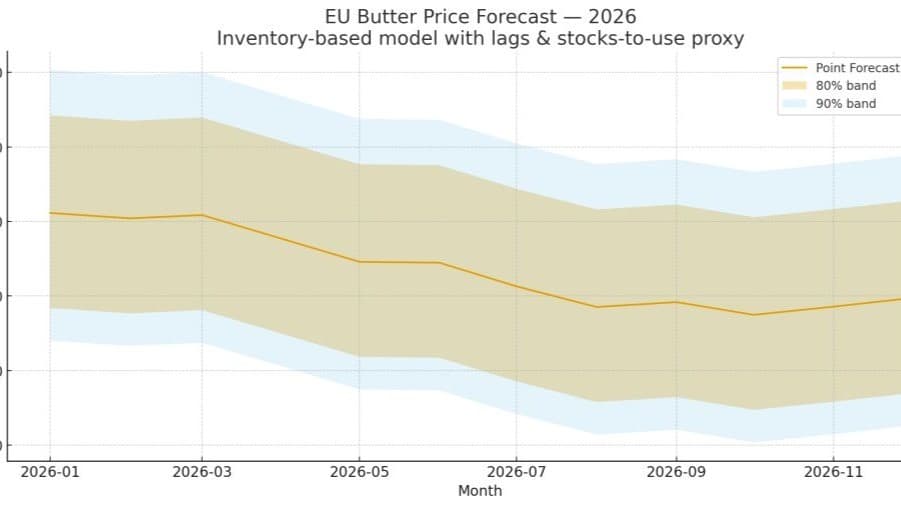
Summer Shopping or Summer Sale?
Last week was again a bit of a bearish week for the entire dairy industry. With cream prices under pressure and milk intake still strong, we keep seeing a market that has more supply than demand. Butter prices took another step lower, cheese prices cracked, and the powder market gave back a bit of its gains again.
The weekly report
Get it before it is anywhere else
Every market report, straight to your inbox the moment it is written. Butter, cheese, powder, liquids — pick what you actually trade.
Roughly weekly · Free · Unsubscribe any time