Fear, Fundamentals, and Freaking Oil Prices

Last week, the market was nervous. This week it started exactly where it left off — nervous, loud, and apparently on stimulants. Over 1,000 MT brokered on a Monday alone. The market doesn't feel like it's running hot anymore. It feels like it's about to trip over its own shoelaces, spin twice, and land face-first into a pile of invoices. Oil is up. Inflation fears are back on the menu. The dollar is stronger, which is good news for European exporters — a silver lining if you squint hard enough through the smoke. Transport costs are climbing, several shipping routes have effectively been declared useless until further notice, and the cost of living in Asia is taking a serious hit as energy prices surge. From the White House, a new narrative arrives approximately every hour, occasionally contradicting the last one.
And somewhere in the middle of all this glorious mayhem, European market participants are doing what they do best: trying to find logic in a situation that has explicitly decided not to have any. Welcome to your weekly update. Where prices this week will trade to, we don't know, but it's going to be volatile, that's for sure. So buckle up — it's going to be another one of those weeks.
Freaking High Oil Prices
There is plenty to write about this week. There is also, paradoxically, nothing to write about — because for every analysis pointing one direction, another equally credible voice points the opposite way. We spent the weekend reading. A lot. And we came out the other side with more questions than answers, which means we fit right in with everyone else.
Take oil. One of the most respected traders in the space sees prices retreating toward $60 a barrel. Another, equally decorated, equally confident, sees a clear path to $150. Both are serious people. Both cannot be right. Welcome to the market of 2026.
On the inflationary impact of higher oil prices, there is at least some consensus: transport gets more expensive, production costs rise across commodities, and interest rate pressure builds. On that, most analysts agree. But the moment you ask what higher oil prices specifically mean for dairy commodity prices, the consensus dissolves entirely. We have all been trained on the same assumption — oil up, dairy up — but when you go looking for that correlation in recent data, it starts to look more like folklore than fact.
Here is the nuance that matters. Higher oil prices can reflect a strong global economy — rising demand, expanding markets, more buying power. In that context, yes, they carry a bullish signal for commodities. But that is not what is driving the current rally. This move is supply-side. A lack of supply, or more precisely, a lack of access to supply. That distinction changes everything. Rather than being a symptom of economic strength, these higher oil prices are actively crushing the buying power of several economies — making the current rally more bearish for some markets than bullish.
Cast your mind back to the $60–70 per barrel range that preceded the war. That wasn't just a number. It was a market telling you something: uncertainty, lack of conviction, a global economy holding its breath. We wrote about it then. The return to elevated prices doesn't mean the world got healthier. It means something else broke.
The most concrete impact we see right now is straightforward and painful: inland transport costs are up, sea freight is up, and surcharges have stacked on top of both. Export costs have risen sharply. That part, at least, is not a matter of debate. The impact of those higher cost are.
Fundamentals: More Milk
We are back with our fundamental analysis — though we should be upfront about something before diving in: right now, fundamentals are fighting above their weight class. They are being outpunched, outmanoeuvred, and frankly embarrassed by something far less rational. Fear.
But let's look at the numbers anyway, because they deserve to be seen.
Someone sent us a file with the January milk production data for the EU and the wider world. We opened it. We read it. We read it again. The EU produced 4.8% more milk in January year-on-year — with Germany up 7%, France up 5.8%, the Netherlands up 6.3%, Italy up 6.8%, and Belgium leading the pack at a remarkable 10.5%. On milk solids, the increase was even more pronounced: the EU delivered 5.7% more milk solids in January. 5.7%. In a career spent trading and brokering dairy, we cannot find a comparable figure. That is not a rounding error. That is a statement.
And it is not just Europe. New Zealand was up 2% in January. The US up 3.2%. Argentina up 9.7%. Australia rounded out the top five with a 1.5% increase. Combined, the world's five largest dairy-producing regions pushed out 4.1% more milk last month than a year ago.
Now here is the question that should be keeping every analyst up at night: how is a market swimming in this much milk simultaneously watching SMP prices rise, butter trading near recent record highs, and powders pushing further still? The CME pulled back from its peaks, yes — but it has recovered in the last two sessions. The direction of travel remains upward.
Our working theory has been fear. Buyers, spooked by geopolitical noise and supply chain uncertainty, are front-running sellers. They are buying more than they need, earlier than they need it, creating the appearance of a shortage that does not exist in the physical market. An artificial tightness, manufactured by anxiety.
But we will be honest with you — and with ourselves. That analysis has a shelf life. If sellers do not need to chase buyers, if the demand is genuinely there and simply not being chased, then this imbalance could be stickier than we expected. Higher prices supported not by fear alone, but by a new equilibrium nobody planned for.
So is fear driving this market? Probably, in part. But to offset a 4.1% increase in global milk production through sentiment alone — that stretches credibility. Something else is in the mix. We just haven't found it yet. And until we do, we will keep watching, keep reading, and keep being honest about what we don't know.
GDT: Bullish Again
This week's Global Dairy Trade auction arrives at the right moment — the market needs a benchmark, and it is about to get one. Our headline call: bullish, with powders stealing the show.
We expect European SMP prices to push well above €2,700 — a level that would have looked aggressive a few months ago but now feels like the floor of the conversation. NZX futures are pointing higher with conviction, and WMP should follow the same direction. We have been speaking to traders ahead of the tender, and while the consensus is bullish, the range of expectations is wide. Some are expecting fireworks. Others are expecting fireworks with a bigger budget. The dispersion of views is itself a signal.
On the fat side, the picture is more nuanced — and more interesting. EU butter is set for a firm correction. Solaris butter traded close to €5,000 last week, which in the light of today seems like an overreaction to the start of the war in Iran two weeks ago. We expect the tender to land somewhere between €4,700 and €4,800. The relatively small offered volume will keep prices on the higher end of that range — limited supply has a way of doing that — but the direction is corrective.
NZ butter, as always, reserves the right to surprise us. The futures curve shows heavy backwardation from July onwards, and we would expect buyers with flexibility — those who can delay purchases or source EU or US origin instead — to look for alternatives rather than chase NZ at current levels. On paper, the futures suggest stable to slightly higher. In our gut, we expect NZ butter and AMF — also heavily backwardated — to correct lower. We have been wrong on NZ butter before. We expect to be wrong on NZ butter again at some point. We are going with gut feeling anyway.
Finally, EU Mozzarella. Trading comfortably above €3,600 still feels like a stretch, but we do expect prices to close above the previous tender. A step up, not a leap — but in this market, steps add up quickly. GDT results will tell us a great deal. We will be watching closely.
EU Butter: Under Pressure
The EU butter market is feeling the weight of the week. NL/DE/BE butter has slipped below €4,600 for nearby delivery, with broader origin spec trading closer to €4,500. Not a collapse — but a notable step down from the levels that were commanding attention just days ago.
The pressure appears to be coming from cream. Last week, cream was trading up to nearly €5,800 DAP. This week, we are hearing prices back below €5,000 EXW. That is a significant move in a short window, and it has fed through to butter with the kind of efficiency the market reserves for corrections.
The timing is mildly surprising. With Easter approaching, the next week or two should carry some seasonal demand support — and yet the buying appetite is not showing up the way you might expect. With over 700 MT of butter traded, the Q2 order book is filling up, but enthusiasm is fading. Most buyers have already shifted their attention toward Q4. Q3 demand, for now, appears limited. The market is not panicking — it is just quietly moving on.
EU SMP: Still Running
The powder market tells a different story. While butter takes a breather, SMP continues its bullrun with quiet confidence. Over 400 MT of powder traded above €2,700 for April — and the market keeps testing new highs without much drama.
We expect a relatively calm session ahead of GDT. The EU market seems content to wait for direction before making its next move. But once the auction outcome becomes clear, we expect the momentum to resume.
The real winners in this environment are those with free drying capacity. Forward sellers are pricing SMP for the coming weeks below €1,000 for raw material — and those who can convert that into powder are capturing margins that, frankly, we have not seen before. If you have the capacity, this market is paying you to use it. If you don't, you are watching someone else's best quarter from the sidelines.
Final Note
If you made it this far, you now know everything we know — which is both more and less than you probably hoped for. The market is loud, the signals are mixed, and the one thing every analyst agrees on is that nobody fully agrees on anything right now.
What we do know: there is more milk than this market should be able to ignore. There is more fear than the fundamentals justify. There is more volume trading than the sentiment would suggest. And there is more chaos coming out of Washington in a single afternoon than most markets process in a quarter.
European buyers and sellers are doing what they always do — finding a way to trade through the noise. That, at least, is reliable.
We will be back later this week. The market will still be complicated. We will still be honest about what we don't know. Until then — stay sharp, stay flexible, and if someone offers you free drying capacity, take it.
Good trading. 🤝 — The GFD Team
More from the desk
Our Long View Before Our Long Break 
Our Long View Before Our Long Break
Last week the market found a bit of stability. After lower trades on cheese, the cheese market traded slowly up, although a real rally remains absent. Butter prices did dip a bit further, although at the start of this week we see some strength on the back end of the curve. And on powder, our bullish feeling just doesn't go away — and now we can find some confirmation in the market as well.
Dairy Carry Has a Shelf Life 
Dairy Carry Has a Shelf Life
Last week was bearish across the board — every product we broker leaned the wrong way. Powders lost more momentum, cheese slipped well below €3,000 for some products, and butter continues to impress with just how much keeps showing up. Supply, supply, supply.
Summer Shopping or Summer Sale? 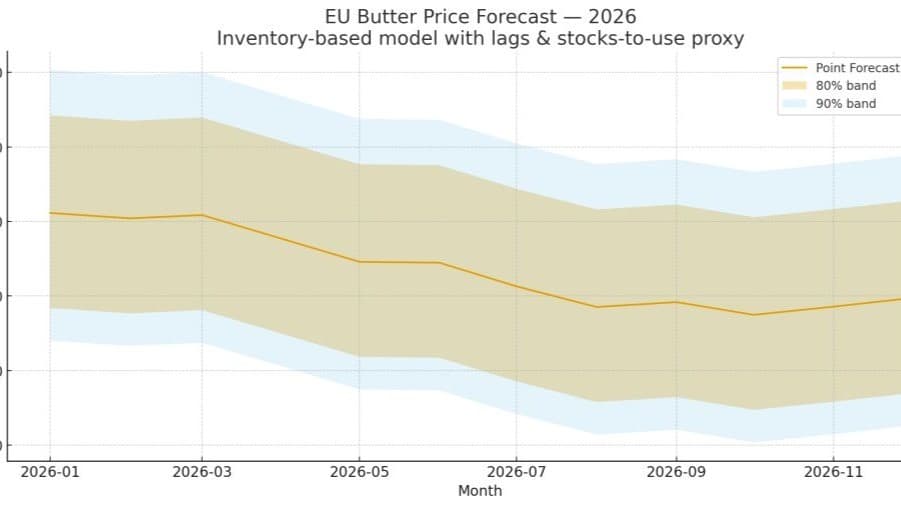
Summer Shopping or Summer Sale?
Last week was again a bit of a bearish week for the entire dairy industry. With cream prices under pressure and milk intake still strong, we keep seeing a market that has more supply than demand. Butter prices took another step lower, cheese prices cracked, and the powder market gave back a bit of its gains again.
The weekly report
Get it before it is anywhere else
Every market report, straight to your inbox the moment it is written. Butter, cheese, powder, liquids — pick what you actually trade.
Roughly weekly · Free · Unsubscribe any time