Bullish Data v.s. Bearish Sentiment

Last week was a strange week in our opinion. Higher quotations, lower production numbers, and a higher GDT should all contribute to an already bullish sentiment, but at the end of the week, we saw most commodities trade lower. As we have been reporting fairly bullish about the market despite some bearish feedback, we had a few "I told you so" coming. But in all fairness, we have been taken a bit by surprise by the bearish moves the market is making. We mainly see lower prices in the butter market, but cheese and powder show some lower trades as well. So is the market breaking? Or should we prepare for a bounce? Is the data leading? Or can Sentiment take the market on a new path?
First of all, what is causing the bearish sentiment? We are not quite sure, but there are two ingredients that are mentioned most by our partners. The first thing is the expected milk intake. So far the EU is roughly on par with the milk collections from last year. There are big discrepancies within the EU. Poland is producing big surpluses in their YoY milk collections, while Ireland is in a big deficit. But where the expectation is that Poland will continue to produce more milk, most expect the Irish to close the gap with their YoY deficits. In fact, the conditions in the EU are perfect for more milk. We are almost halfway through June and it seems we do not need to fear a drought in the west EU, feed prices are manageable, and milk prices are already good, and expected to rise. More milk therefore isn't an unlikely scenario. But if the EU can ramp up its milk collection the concerns about deficits on some products could reverse.
Another argument from our partners for lower prices is the high prices. Especially butter buyers have to cover their needs well above cost price levels and most expect that once these butter price levels hit the retail, demand will collapse/decline. We do acknowledge that big end users are delaying purchases, but we do expect most to come back to the market. In the end, its the consumer that decides if the higher prices are sustainable. As long as the consumer keeps paying higher prices, we do not expect demand to fade. So far, consumption seems to be holding up well. And if consumers keep buying, we expect the end user to come back to the market in the next weeks as well. Looking at the cheese and powder market we dont think that the current prices form any threat to consumption. Two years ago the cheese price was roughly 25% higher and still the order managed to keep coming.
Ok, so more milk and lower demand seem to be good arguments for lower prices, what could hold the prices higher?
Stocks and Commodity Production
The biggest argument here is low stocks and low production. But to start off with the first, this seems hard to measure. We use two information platforms that both produce different outcomes for the stock levels in the EU. They both have a different interpretation of the data available, and our partners (and we) choose to look a the data that suits their argument best. But going through it by-product from our point of view, we seem to agree with the lower stock analysis.
Cheese Stocks: No Signinfican Changes
Most cheeses we broker are not stored and stocked a lot. Fresh mozzarella is usually grated or sliced 4 weeks after production, and Edam and Gouda are usually sliced within 8 weeks of production. Looking at the age of all products, we feel the market is relatively clean. For Mozzarella we had problems securing volume for prompt delivery and for Gouda and Edam the age remains within the 4-5 weeks of age. This during peak milk seems ok. But looking at the price of SWC and SWP it does seem that production remains strong, so we should not expect any decline in cheese stocks.
Powder Stocks: Nearing long term bottom
Looking at the powder stock levels produced on our information platform we do see differences, but both are calculating very low stocks for SMP in the EU, but also in the US. Stock are historically low, and the fact that protein prices linger on the low end of the yearlong average clearly shows that demand has been poor as well. But at some stage, we expect demand to return and then these stock levels form the most bullish fundament for any dairy commodity we have seen in recent years. To compare, smp stocks in the EU are roughly 50.000 lower compared to 2021. But as long as demand remains as it is today, these low stocks arent even a reason for prices to climb up.
Butter Stocks: Hitting lowest point since 2010
Ok, the data on these stocks differs most on these platforms, but that mainly is caused by the different numbers on production the data platforms seem to be using. But looking at the data from the most negative platform it shows the stock levels at the moment are roughly down 40% compared to last year. Looking at the production numbers we can find for butter (and these number align across the platforms) we do see how this big deficit came to be. A more than 60,000mt decline in butter stocks compared to March 2023 in our view is a huge impact, given that end-of-year stocks usually differ 10/20.0000 mt YoY. The biggest YoY change we could find was 35.000mt. Looking at the data from one platform that goes back 20 year March 2024 has the lowest butter stock report since 2010!
Production YoY deficits: a Bullish Butter Breakdown
Maybe the reason we are/were so bullish on the markets are the production numbers we have been tracking. To follow up on the low butter stock, that can be tracked back mainly due to the low butter production. Looking back from August to March this year, we are missing 75.000mt of butter production compared to the year before, of this 75.000mt 65.000mt should have been produced between October and March, the period for winter butter production. We cant find any period in the data presented that is showing such a big deficit. This deficit on production comes after a year that the end stocks for EU butter in 2023 were at the lowest point of the last 10 years.
This means butter production needs to ramp up in the next months, but speaking to partners on the production side of the market it seems April and May haven't been strong production months either. If the next months show the same YoY deficit numbers as March (-20.000mt compared to March 2023) the 82.000mt commercial butter stock at the end of the year might not be sufficient to supply all the butter needs for the 2024 season. We would need butter imports, but with the EU on par with the US and cheaper than the NZ we should not expect any relief from these areas.
The butter stock data + production data and the forecast make us extremely bullish on the butter market, and we wonder what has caused the market to reverse last week. For those who might be able to add some data to our analysis, please share it with us.
Cheese Production: Higher Production + Higher Demand = Stable Markets
Looking at the cheese production since summer last year, we might have found an answer to the question, where did all the fat go? Cause with less butter production, but steady milk intake, we should see overproduction somewhere. We clearly see more cheese production in the EU since July last year, and the expectation remains that cheese production will keep its YoY surplus from the previous year. The reason behind this seems to be the extra capacity that has been build in the previous years, but also the stronger demand.
In addition, exports of cheese is taking more cheese out of the EU. In 2023 we saw a 5% increase and looking at the data and listening to our partners, demand from export for cheese remains strong. The higher cheese production has not led to increased stocks, therefor it seems consumption in the EU and production are very well balanced.
Powder Production: Hits World Wide Low
The powder production number we can find makes us more bullish on the market than we already were. As the SMP/NFDM market is much more world wide markets, we took at the complete picture. Since the summer of last year, the US and EU have been on a YoY deficit streak, leading to the low stocks we speak about in the article above.
With 55.000mt the EU has a YoY deficit from August to March we see that the EU is not adding more products to a market that doesn't need it. in the US we have seen a similar trend and the latest reports from Oceania show us less SMP production over the latest months as well.
So if we summarize the above article we do not really understand the more bearish sentiment on commodities. Unless milk production will really get a boost we might see some relief, but some product just remain incredibly bullish from a data point of view. It's the sentiment that comes with high prices that is pushing the prices down. It seems some expect a quick and large reversal in the cheese and butter market, but mainly due to the fact we are already on relatively high levels. But if we would present the same fundamental data without mentioning the prices, we are sure we would find a lot less bearish market partners. So the big question is, is it fair to take price out of the equation? Or are the high prices a real reason to become bearish? Please share with us your thoughts.
More from the desk
Our Long View Before Our Long Break 
Our Long View Before Our Long Break
Last week the market found a bit of stability. After lower trades on cheese, the cheese market traded slowly up, although a real rally remains absent. Butter prices did dip a bit further, although at the start of this week we see some strength on the back end of the curve. And on powder, our bullish feeling just doesn't go away — and now we can find some confirmation in the market as well.
Dairy Carry Has a Shelf Life 
Dairy Carry Has a Shelf Life
Last week was bearish across the board — every product we broker leaned the wrong way. Powders lost more momentum, cheese slipped well below €3,000 for some products, and butter continues to impress with just how much keeps showing up. Supply, supply, supply.
Summer Shopping or Summer Sale? 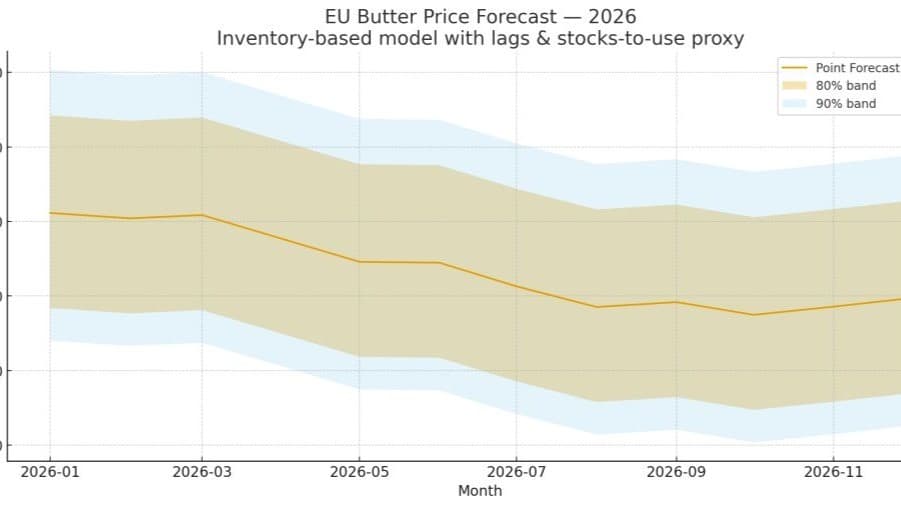
Summer Shopping or Summer Sale?
Last week was again a bit of a bearish week for the entire dairy industry. With cream prices under pressure and milk intake still strong, we keep seeing a market that has more supply than demand. Butter prices took another step lower, cheese prices cracked, and the powder market gave back a bit of its gains again.
The weekly report
Get it before it is anywhere else
Every market report, straight to your inbox the moment it is written. Butter, cheese, powder, liquids — pick what you actually trade.
Roughly weekly · Free · Unsubscribe any time